In 1994, the U.S. Army-Baylor University Graduate Program in HCA became part of the newly founded Center for Healthcare Education and Studies at the AMEDD's Academy of Health Sciences (AHS) at Ft. Sam Houston, Texas. In response to the Congressional mandate, an ongoing research initiative was undertaken in late 1992 by the U.S. Army-Baylor program faculty, under the direction of the Dean of AHS, Colonel Paul Brooke, Jr., and the director of Army-Baylor, Colonel Ronald Hudak, to study and examine the executive skills, knowledge, and abilities projected to be required by both military and civilian health care professionals, managers, executives and administrators. To date these Delphi methodology research studies have examined health care executive and administrative job requirements for U.S. Army hospital commanders and deputies for administration, fellows of the American College of Health Care Executives (ACHE), fellows of the American College of Medical Practice Executives (ACMPE) - the professional development and credentialing arm of the Medical Group Management Association (MGMA), members of MGMA's Society of Physician Executives (SPE), the American College of Physician Executives (ACPE), U.S. Army Medical Service Corps officers, U.S. Army nurse administrators, U.S. Navy hospital administrators, U.S. Coast Guard health care executives, U.S. Army and U.S. Navy dentists, and DoD and civilian pharmacists. The Executive Skills Program report was the foundation for future studies supporting competency-based curricula.
Bailey, L.A. (2020). An exploration of military faculty turnover on student learning in a competency development model. The University of Texas at San Antonio ProQuest Dissertations & Theses, 2020. 27837502.
Beauvais, B., Kim, F., Cuyler, M., Richter, J., Johnson, L., & Mangelsdorff, A. D. (2016). Developing the BEAR: Assessing student competency development in graduate health management education. Journal of Health Administration Education, 33(3), 377–392.
Beauvais, B., Richter, J., Cuyler, M., Bewley, L., & Kim, F. (2016). Portfolio development to guide competency assessment & disseminate health system leading practices: Results from the Army-Baylor residency experience. Journal of Health Administration Education, 33(4), 541–557.
Beauvais, B., Richter, J., Kim, F., Weigel, F., Brezinski, P., Downs, L., Mangelsdorff, A.D., … Powers, J. (2017). The Influence of CAHME Accreditation Findings and Program Reputation on Length of Healthcare Management Program Accreditation. The Journal of Health Administration Education, 34(4), 569.
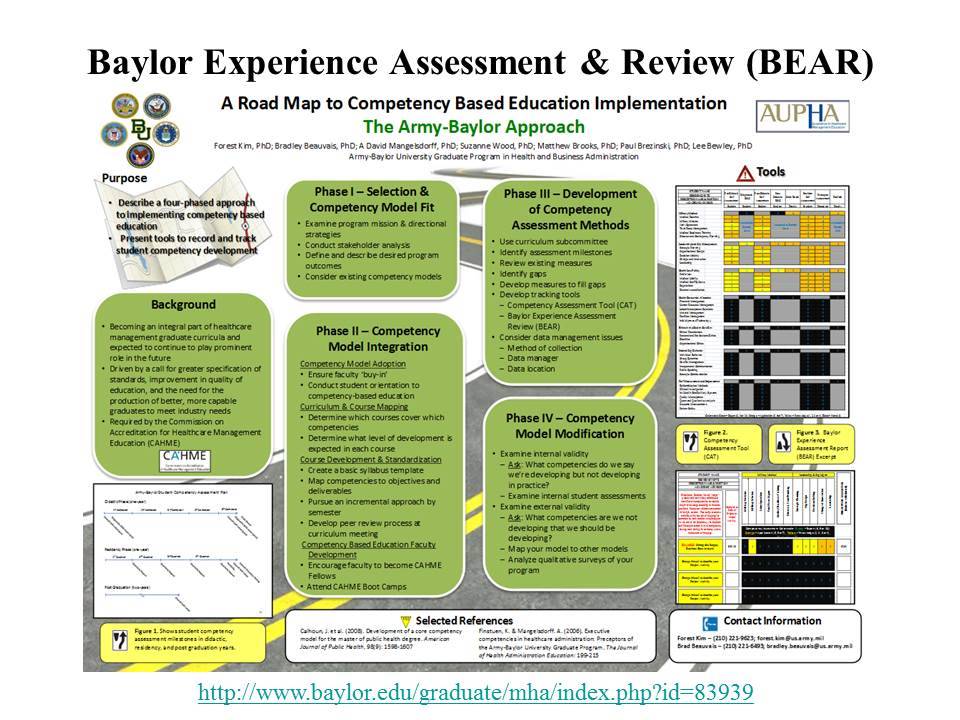
Beauvais, B., Wood, S. J., Brezinski, P., Brooks, M., Kim, F., & Mangelsdorff, A. D. (2011). Adoption and implementation of competency based education—the Army-Baylor approach. Journal of Health Administration Education, 28(4), 299–313.
Bewley, L. W., Bonica, M. J., Hernandez, S. R., & Shewchuk, R. M. (2016). Mentorship mediated by life-career seasons: an analysis of a multi-dimensional model of mentoring among career groups of United States Army Officers. Glob J Manage Bus Res, 16(8), 34–45.
Bewley, L. W., Broom, K. D., & Bonica, M. (2014). What is the value of graduate education? An economic analysis of army medical department graduate programs. US Army Medical Department Journal, 7. ISSN 1524-0436.
Bhavsar, G. P., & Newman, J. (2024). Where’s the Data? An Exploratory Study into Data Curriculum in CAHME-Accredited Graduate Health Administration Programs. Journal of Health Administration Education, 40(4), 561–576.
Bhuyan, S., & Broom, K. D. (2025). Fundamentals of Healthcare Management: Theory and Practice. Springer Publishing.
Bonica, M. J., & Hartman, C. (2018). Managing up and followership: Competencies for first-year health administrators. Journal of Health Administration Education 35(3), 327-352.
Bonica, M. J., & Bewley, L. W. (2019). A comparison of mentorship attitudes and attributes between civilian and army healthcare leaders. Military Medicine, 184(5–6), e255–e262.
Brooke, P. P., Hudak, R. P., Finstuen, K., & Trounson, J. (1998). Management competencies required on ambulatory care settings.(Physician Executive Management Competencies). Physician Executive, 24(5), 32–39.
Broom, K. D. (2014). What is the Value of Graduate Education? An Economic Analysis of Army Medical Department Graduate Programs. Commander’s Introduction. U.S. Army Medical Department Journal, 7. ISSN 1524-0436.
Chaffin, J.G., Chaffin, S.D., Mangelsdorff, A. D., & Finstuen, K. (2007). Patient satisfaction with dental hygiene providers in US military clinics. American Dental Hygienists’ Association, 81(1), 9–9.
Coates, H. R., Silvernail, T. S., Fulton, L. V., & Ivanitskaya, L. (2011). The effectiveness of the recent army captain retention program. Armed Forces & Society, 37(1), 5–18.
Cunningham, J., Key, E., & Capron, R. (2016). An evaluation of competency-based education programs: A study of the development process of competency-Based programs. The Journal of Competency-Based Education, 1(3), 130–139.
Dexter, K. H. (1999). Who shall lead? Civilian leadership skills for the 21st Century Army Medical Department. Army Management Staff College.
Ferro, A., Stubbs, E., & Bailey, L. (2024). Self-Improvement through Coaching for Enhanced Measures (SICEM) at Army Baylor. Chronicle of Mentoring and Coaching, 8(3), 323-327. https://doi.org/10.62935/4p5cxu
Finstuen, K., & Mangelsdorff, A. D. (2005). Executive competencies in health care research: a decade of assessment. US Army Medical Department Journal, 8, 24–26. DTIC: ADA430431.
Finstuen, K., & Mangelsdorff, A. D. (2006). Executive competencies in healthcare administration: preceptors of the Army-Baylor University Graduate Program. Journal of Health Administration Education, 23(2), 199–215.
Fulton, L.V., Mangelsdorff, D., & Bewley, L. (2009). An analysis of statistics education technologies in graduate health and business administration. International Conference of Education, Research and Innovation, 4722-4727, ISSN: 2340-1095.
Fulton, L.V., Mangelsdorff, A. D., & Finstuen, K. (2008). Using Anscombe’s quartet plus one to illustrate data set matching, proper model specification, and relationships between inferential tests. Journal of Health Administration Education, 25(2), 145–158.
Garman, A.N. (2018). Competency-based education in healthcare management Current state & future directions. Journal of Health Administration Education, 35(2), 1999-119-122.
Guo, R., Berkshire, S. D., Fulton, L. V., & Hermanson, P. M. (2017). Use of evidence-based management in healthcare administration decision-making. Leadership in Health Services, 30(3), 330–342. https://doi.org/10.1108/LHS-07-2016-0033
Guo, R., Berkshire, S. D., Fulton, L. V., & Hermanson, P. M. (2018). Factors Affecting the Adoption of Evidence-based Management among US Healthcare Administrators. American Journal of Management, 18(1), 36-47.
Hernandez, S. R., & Shewchuk, R. (2008). Competencies and curriculum content: what works for our programs? Journal of Health Administration Education, 25(2), 81-85.
Hooker, E. A., Mallow, P., Downes, C., & Baidwan, S. (2022). Abandoning the GRE and GMAT improved diversity in a graduate program for health administration. Journal of Health Administration Education, 38(4), 895–912.
Houser, B. L. (2017). Competency-Based Education: A Quantitative Study of the US Air Force Noncommissioned Officer Academy (Doctoral dissertation). Capella University.
Hudak, R. P., Brooke, C. P. P., Jr, Finstuen, K., & Riley, M. P. (1993). Health Care Administration in the Year 2000: Practitioners’ Views of Future Issues and Job Requirements1. Journal of Healthcare Management, 38(2), 181–195.
Hudak, R. P., Brooke, P. P., Jr, & Finstuen, K. (2000). Identifying management competencies for health care executives: review of a series of Delphi studies. The Journal of Health Administration Education, 18(2), 213–243.
Hudak, R. P., Brooke, P. P., Jr, Finstuen, K., & Trounson, J. (1997). Management competencies for medical practice executives: Skills, knowledge and abilities required for the future. Journal of Health Administration Education, 15(4), 219–239.
Hudak, R.P. (2005). Program Director Profiles. Army Medical Journal, Jan. – Mar., 29. DTIC: ADA430431.
Hudak, R.P., Brooke, P. P., & Finstuen, K. (1994). Forecast 2000: a prediction of skills, knowledge, and abilities required by senior medical treatment facility leaders into the 21st century. Military Medicine, 159(7), 494–500.
Hudak, R.P., Brooke, P. P., Finstuen, K., & Trounson, J. (2002). Physician Executives Share Insights on Ways to Influence People. Physician Executive, 28(4).
Hudak, R.P., Jacoby, I., Meyer, G. S., Potter, A. L., Hooper, T. I., & Krakauer, H. (1997). Competency in health care management: a training model in epidemiologic methods for assessing and improving the quality of clinical practice through evidence-based decision making. Quality Management in Healthcare, 6(1), 23–33.
Hudak, R.P., Russell, R., Fung, M. L., & Rosenkrans, W. (2015). Federal health care leadership skills required in the 21st century. Journal of Leadership Studies, 9(3), 8–22.
Kim, F.S., Beauvais, D.M., Mangelsdorff, A.D....Bewley, L. (2011). Army-Baylor Univ. Competency model: Baylor Experience Assessment & Review (BEAR). Presented at AUPHA meeting, Charleston, S.C., June, 2011.
Kim, F. S., Bonica, M., Johnson, L. M., Swift, D., Beauvais, B. M., & Mangelsdorff, A. D. (2021). ‘ Throw You to the Wolves’ and Other Strategies for Developing the Interpersonal Skills of Recent Entrants to Healthcare Management: A Mixed-Methods Study. Journal of Health Administration Education, 38(3), 727–768.
Liang, Z., Howard, P. F., Leggat, S., & Bartram, T. (2018). Development and validation of health service management competencies. Journal of Health Organization and Management, 32(2), 157–175.
Mangelsdorff, A.D. (1999). Military Cohesion. Journal of Military Psychology, 11(1).
Mangelsdorff, A. D. (2005). Evidence-based Outcomes. US Army Medical Department Journal, 14–18. DTIC: ADA430431.
Mangelsdorff, A. D. (2005). The Army-Baylor program in healthcare administration. U S Army Medical Department Journal, 1–3. DTIC: ADA430431.
Mangelsdorff, A. D. (2014). Competency-based curriculum, outcomes, and leader development: Applications to a graduate program in health administration. Journal of Health Administration Education, 31(2), 111–133.
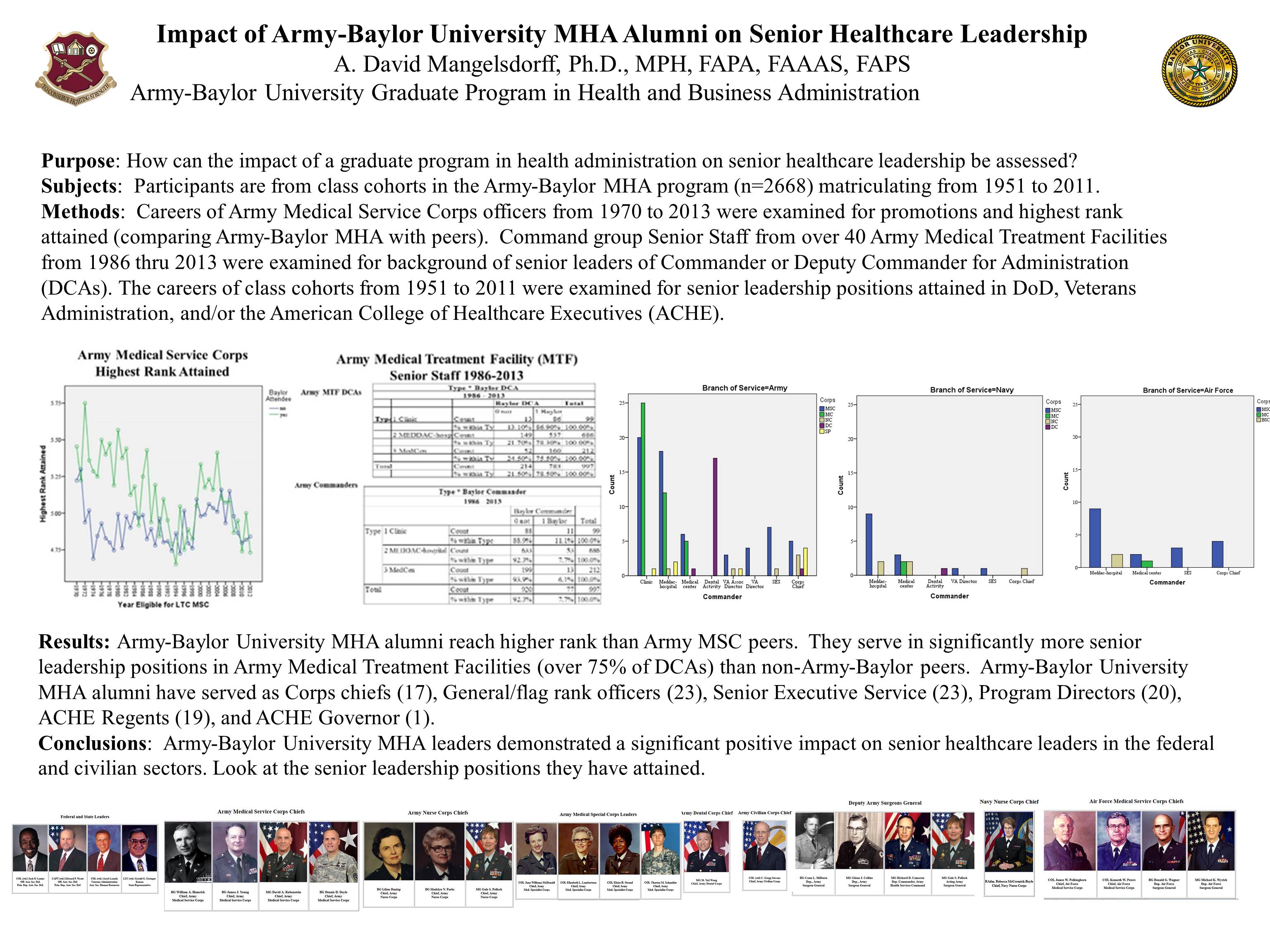
Mangelsdorff, A.D. Impact of Army-Baylor Univ. MHA Alumni on Senior Healthcare Leadership Organizations. Presented at 2016 AMEDD Graduate School Research Symposium, Fort Sam Houston, TX, April, 2016.
Mangelsdorff, A.D. Impact of Army-Baylor University MHA Alumni on Senior Healthcare Leadership presented at 2016 AMEDD Graduate School Research Symposium, Fort Sam Houston, TX, April, 2016.
Mangelsdorff, A. D., & Finstuen, K. (2003). Patient satisfaction in military medicine: status and an empirical test of a model. Military Medicine, 168(9), 744–749. https://doi.org/10.1093/milmed/168.9.744.
Mangelsdorff, A. D., & Finstuen, K. (1999.). Forecast for success. US Army Medical Service. DTIC ADA364063.
Mangelsdorff, A. D., Finstuen, K., & Pryor, R. (2003). 50 Years of Scholarship in Action.
Mangelsdorff, A. D., Finstuen, K., & Rogers, J. R. (1999). Forecast For Success-US Army Medical Service Corps Officers. DTIC ADA364063.
Mangelsdorff, A. D., Finstuen, K., Larsen, S. D., & Weinberg, E. J. (2005). Patient satisfaction in military medicine: model refinement and assessment of Department of Defense effects. Military Medicine, 170(4), 309–314. https://doi.org/10.7205/MILMED.170.4.309
Mangelsdorff, A. D., Finstuen, P. K., & Pryor, R. (2005). The US Army-Baylor Program: 50 Years of Scholarship In Action. AMEDD Journal. Jan. – Mar., 5. DTIC: ADA430431.
Mangelsdorff, A.D., and Johnson, L.M. (2017). Health Care Statesmen Forged Under Fire: A Sixty Year History of the Army-Baylor University MHA Program. ISBN 978-0-9990765-0-7. San Antonio, TX: Shweiki Media.
Mangelsdorff, A. D., Rogers, J. R., Zucker, K. W., Thieschafer, C. L., Hagen, J. P., & Finstuen, K. (1997). Vision 21 Delphi panel: Senior Army medical service corps officers’ vision of behaviors for success of future medical service corps officers. Military Medicine, 162(7), 450–452. https://doi.org/10.1093/milmed/162.7.450
Mangelsdorff, A. D., Rogers, J., Finstuen, K., & Pryor, R. (2004). US Army-Baylor University Health Care Administration Program: evidenced-based outcomes in the military health system. Journal of Health Administration Education, 21(1), 81–89.
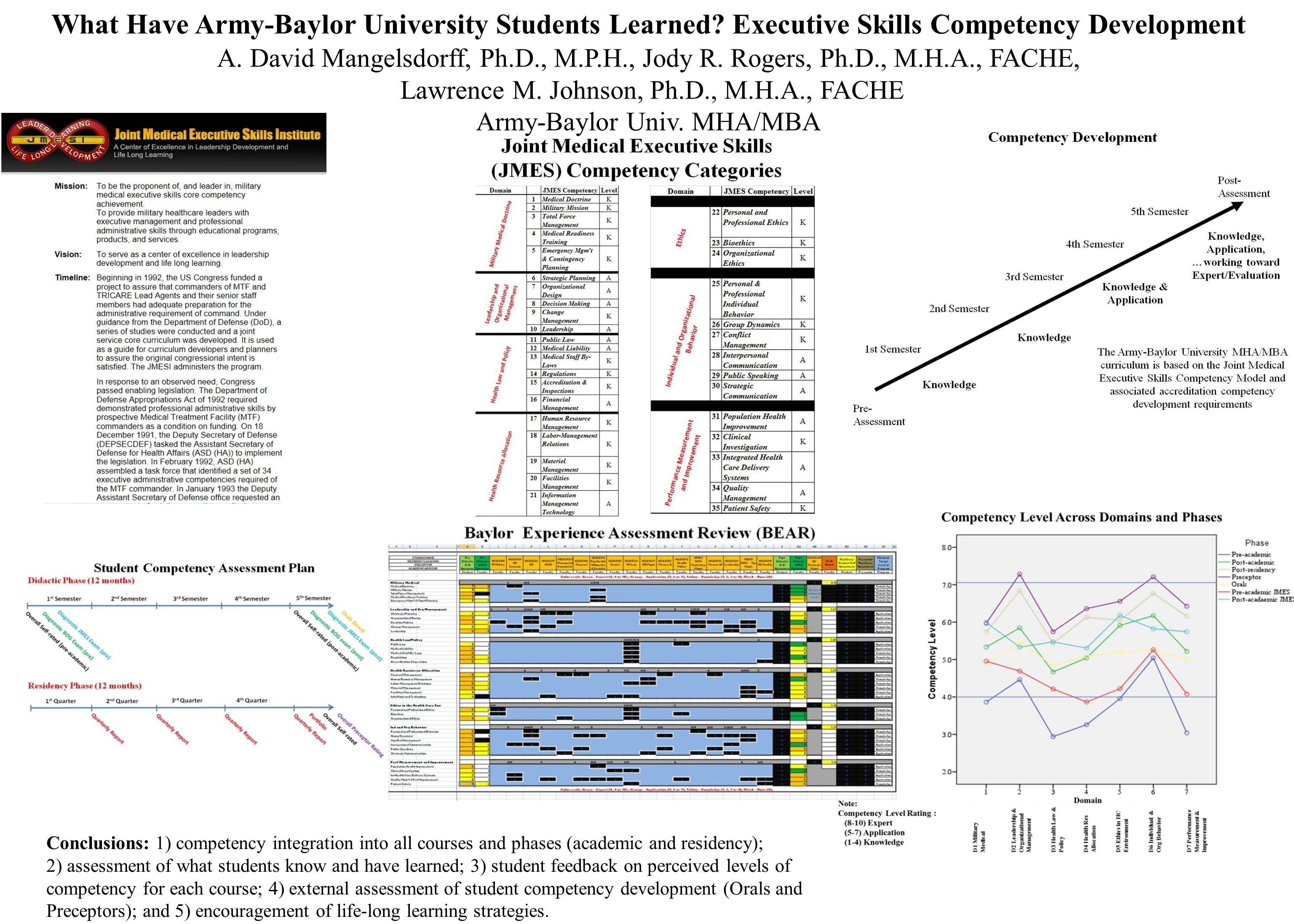
Mangelsdorff, A.D., Rogers, J., & Johnson, L.M. What have Army-Baylor University students learned? Executive Skills Competency Development. Presented at the Association of University Program in Health Administration (AUPHA), San Antonio, Tx, June, 2014.
Mangelsdorff, A.D. & Smith, L.A. Community Disaster Preparedness, Group Dynamics, and Competency Development in Classroom Scenarios presented at the 4th Annual Research Day, Academy of Health Sciences Graduate School, Fort Sam Houston, TX, December, 2014.
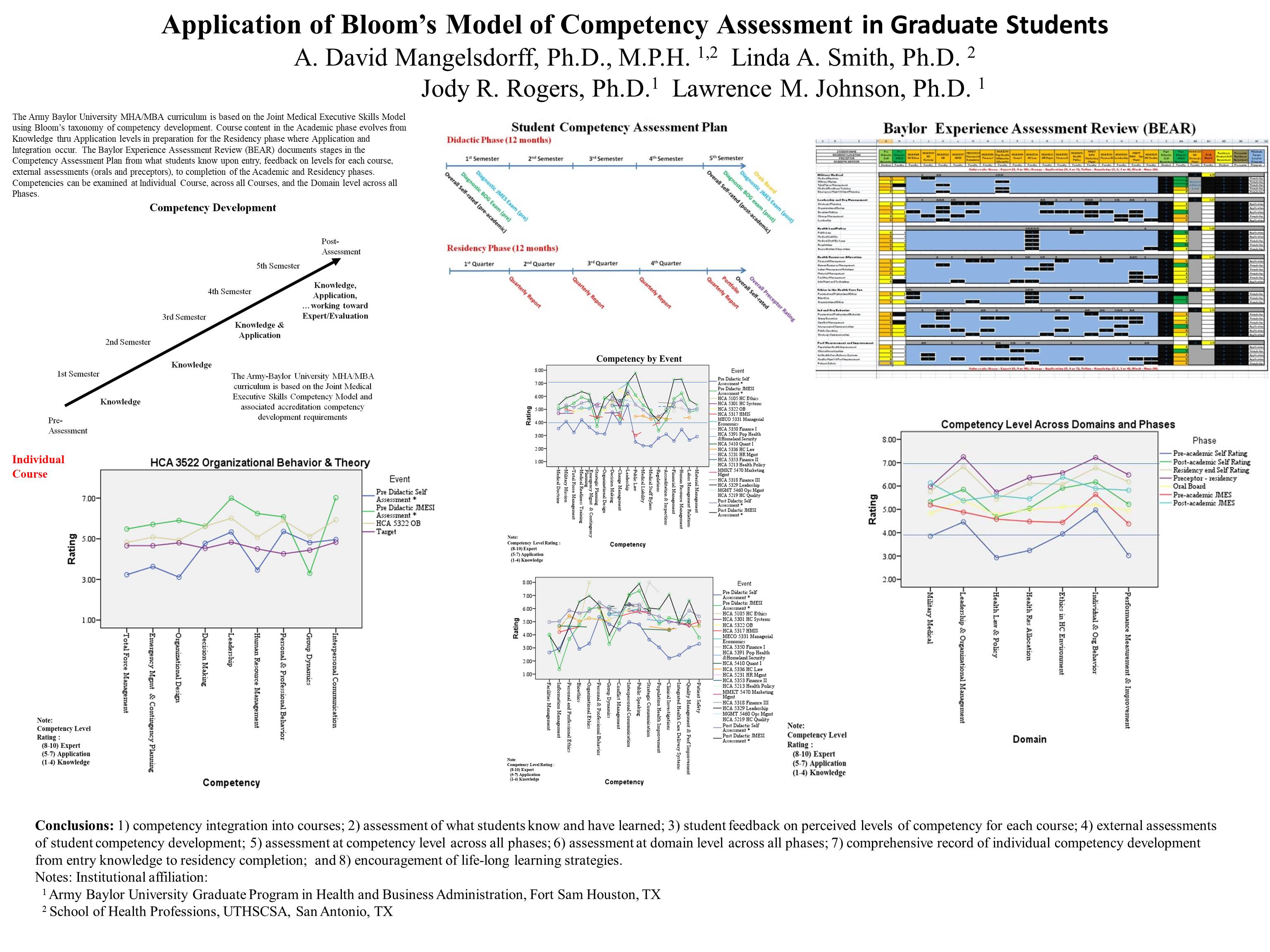
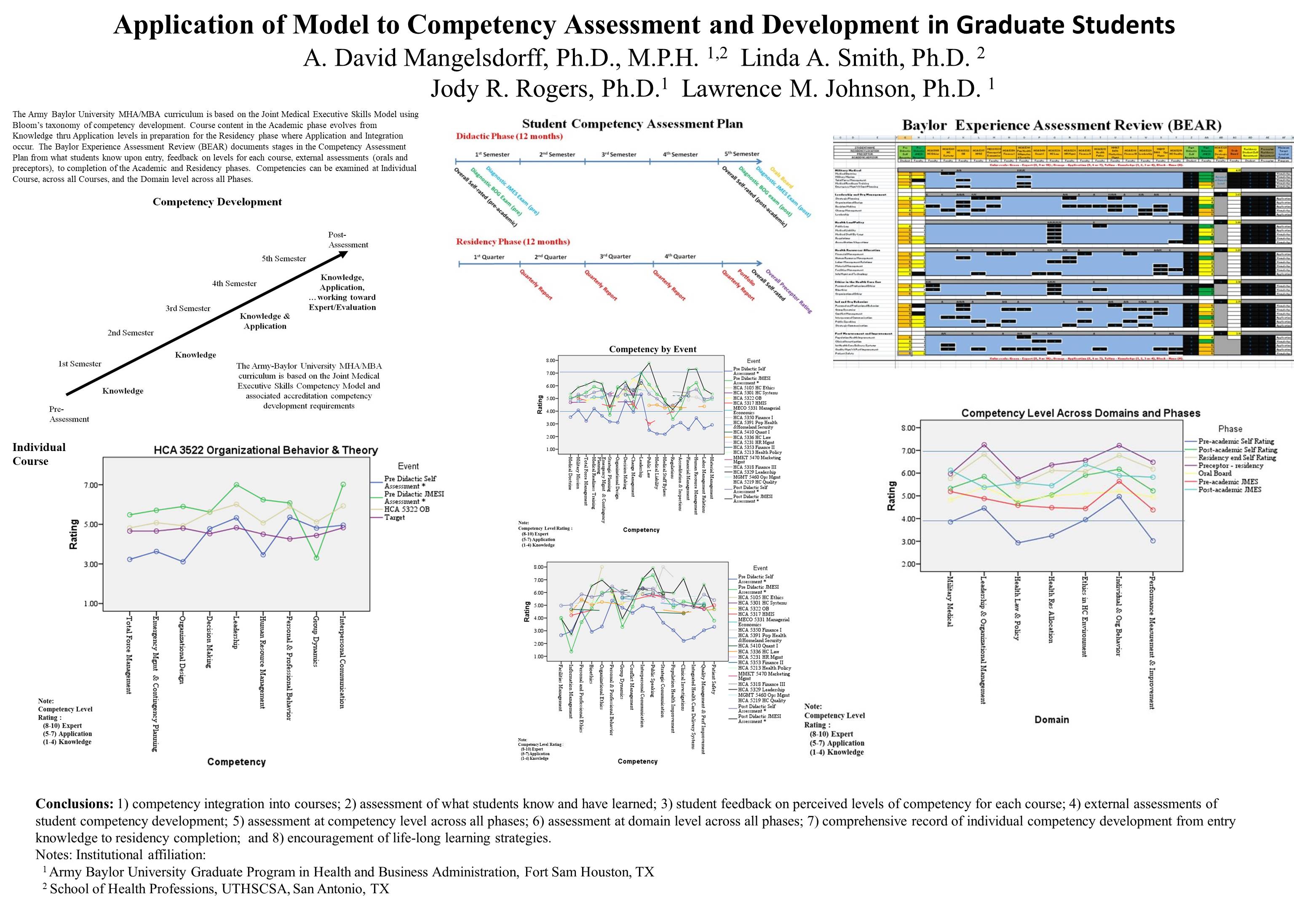
Mangelsdorff, A.D., Smith, L.A., Rogers, J.R., & Johnson, L.M. (2015). Application of Bloom's Model of Competency Assessment in Graduate Students. Presented at AUPHA, San Antonio, TX, June, 2014.
Mangelsdorff, & Smith, L.A. (2016). Classroom Scenarios for Community Disaster Preparedness, Group Dynamics, and Competency Development. Presented at 7th Annual Frontiers of Translational Science Research Day conference at Institute for Integration of Medicine and Science, UTHSCSA, San Antonio, TX, April, 2016.
Mangelsdorff, A.D., Smith, L.A., Rogers, J., and Johnson, L.M. Application of Model to Competency Assessment and Development in Graduate Students presented at the IIMS/CTSA 6th Annual Frontiers of Translational Science Research Conference, UTHSCSA, San Antonio, TX, April, 2015.
Marty, S.A. (2006). Navy health care executive competencies. DTIC ADA473552.
Mast, L. J., Winter, B., Ross, M., & McIntyre-Hite, L. (2018). Program management for faculty development: Addressing the changing faculty roles in a direct assessment competency-based model. Journal of Health Administration Education, 35(2), 279–476.
McIntyre-Hite, L., Kadrie, M., Pederson, H., & Hudgins, T. (2015). Developing an online direct-assessment competency-based masters in healthcare administration: Insights, challenges, and lessons learned. Journal of Health Administration Education, 32(4), 613–619.
Meadows, A. B., Finstuen, K., & Hudak, R. P. (2003). Pharmacy executives: leadership issues and associated skills, knowledge, and abilities in the US Department of Defense. Journal of the American Pharmacists Association, 43(3), 412–418.
Meadows, A. B., Finstuen, K., Hudak, R. P., Carrillo, J. D., Lawrence, J. B., & Wright, K. (2003). Perception of managerial and administrative competencies of professional pharmacists in the US Department of Defense. Journal of the American Pharmacists Association, 43(4), 488–496.
Meadows, A. B., Maine, L. L., Keyes, E. K., Pearson, K., & Finstuen, K. (2005). Pharmacy executive leadership issues and associated skills knowledge and abilities. Journal of the American Pharmacists Association, 45(1), 55–62.
Mulkey, S. L. (2005). At the crossroads: the US Army-Baylor program. US Army Medical Department Journal, 10–14. DTIC: ADA430431.
Palarca, C., Johnson, S., Mangelsdorff, A. D., & Finstuen, K. (2008). Building from within: Identifying leadership competencies for future navy nurse executives. Nursing Administration Quarterly, 32(3), 216–225. https://doi.org/10.1097/01. NAQ.0000325179.09838.13
Pandya, M. N. (2011). A study of patients’ satisfaction measurement in hospital services of selected health care facilities. DIAS Technology Review, 55–63.
Perlin, M. S. (2011). Curriculum mapping for program evaluation and CAHME accreditation. Journal of Health Administration Education, 28(1), 33–53.
Peters, A.D. (2000). Vision 2005: A Forecast of Executive Leadership Skills and Associated Competencies required by Navay Dental Corps Officers. DTIC ADA412605.
Rogers, J., Finstuen, K., Mangelsdorff, A.D., & Snyder, G.L.. (1999). Executive Competencies and skills required by United States Coast Guard Health Care Administrators. AAMA Executive, 10-15.
Schneider, T.M. (2001). The TO and E Hospital as a Baylor Residency site. DTIC AD1199967.
Sentell, J. W., & Finstuen, K. (1998). Executive skills 21: a forecast of leadership skills and associated competencies required by naval hospital administrators into the 21st century. Military Medicine, 163(1), 3–8. https://doi.org/10.1093/milmed/163.1.3
Silvernail, T. S., Coates, H. R., Fulton, L. V., & Childress, C. Y. (2009). Exploring the US News and World Report rankings of masters-level graduate health management programs. Journal of Health Administration Education, 26(4), 293–307.
Smith, B., Hernandez, M., & Gordon, J. (2019). Competency-Based Learning. DTIC AD1077111.
Smith, D. G. (2016). Expectations for Students and Graduates. Journal of Health Administration Education, 33(3), 351.
Smith, D. G. (2018). Competency in health administration education. Journal of Health Administration Education, 35(2), 115.
Snyder, G. (1999). Executive competencies and skills required by United States Coast Guard Health Administrators. DTIC ADA477780.
Stefl, M. E. (2008). Common competencies for all healthcare managers: the Healthcare Leadership Alliance model. Journal of Healthcare Management, 53(6).
Stevens, D. E. E. (2003). Executive Skills 2010: A Toolbox of Competencies for Air Force Medical Service Corps Officers of the 21st Century. US Army Medical Department Center and School.
Sutto, N. B., Knoell, M. D., Zucker, K., Finstuen, K., & Mangelsdorff, A. D. (2008). Executive competencies of nurses in the Veterans Health Administration. Military Medicine, 173(1), 47–53. https://doi.org/10.7205/MILMED.173.1.47
Topinka, J. B. (2014). Legal education for Army Medical Department leaders and soldiers. US Army Medical Department Journal, 68. ISSN 1524-0436.
Walz, T. N., Wood, D., Evans, G., Barnes, B. W., & Others. (2025). Integrating artificial intelligence into program design for future health care leaders: Faculty insights from the Army-Baylor MHA/MBA program. Journal of Health Administration Education, 41(2), 369–392.
Walz, T. N., Wood, D., Jimenez, J. M., Evans, G., & Barnes, B. W. (2025). Innovating Healthcare Management Education With Artificial Intelligence: A Case Study From the Army-Baylor University Graduate Program in Health and Business Administration. Military Medicine, 190 (9-10), e1897. https://doi.org/10.1093/milmed/usaf167
Watson, M. R. (1986). Factors Associated with Student Stress in the US Army-Baylor University Graduate Program in Health Care Administration. https://doi.org:10.21236 DTIC ADA209758
Weigel, F. K., & Bonica, M. (2014). An active learning approach to Bloom's Taxonomy: 2 games, 2 classrooms, 2 methods. U.S. Army Medical Department Journal, 14.
Wineman, J. A., Mangelsdorff, A. D., & Finstuen, K. (1998). Senior executive behaviors for the Army dental care system of the 21st century. Military Medicine, 163(6), 377–380. https://doi.org/10.1093/milmed/163.6.377
Additional AB Graduate Scholarship